
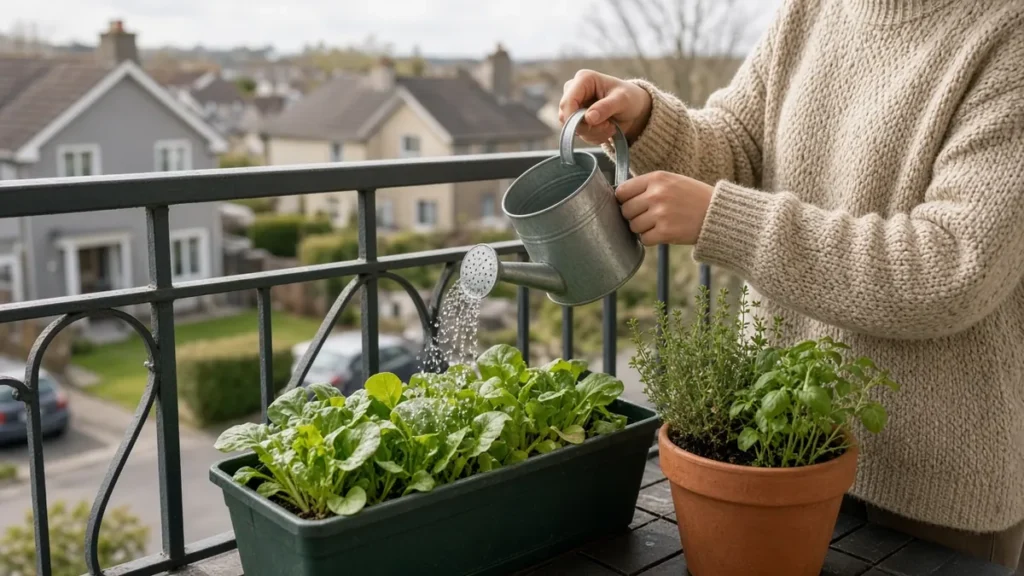
Ask balcony growers in Ireland what gives them most trouble and many will say the wind, not the cold. A breezy balcony dries out pots quickly, knocks over young plants and tears soft leaves. The higher up you are, and the closer to the coast, the more you’ll notice it.
The good news is that a little shelter goes a long way. Here’s how to work with the wind rather than against it.
Get to know your wind
Spend a few blustery days watching your balcony.
- Which way does the wind come from? In much of Ireland the strongest winds often come from the south-west and west, but buildings can funnel wind in surprising directions.
- Where are the calm corners? Spots against a wall or in a recess are often much calmer than the open edge.
- Where does it gust? Corners of buildings and gaps between them can be gusty even on a fairly still day.
Your calmest, sunniest corner is prime growing space. Keep it for the plants that need it most.
Filter the wind, don’t block it
It sounds odd, but a solid barrier isn’t always the best windbreak. Wind can tumble over a solid wall or screen and swirl down on the other side. A screen that lets some air through slows the wind down more gently.
Good options include:
- Trellis or slatted panels, fixed firmly
- Windbreak mesh made for gardens
- Groups of sturdy plants in larger pots, which shelter the smaller ones behind them
Check your lease or management company rules before fixing anything to walls or railings. Some buildings have rules about what can be attached.
Keep everything safe and steady
Safety comes first on a balcony.
- Never place pots on the outside of railings or on ledges where they could fall.
- Use heavier, wider pots for anything tall. They’re harder to tip over.
- Keep big containers near the walls, and check what your balcony is designed to carry.
- Tie in climbing plants to their supports so they don’t flap about.
- Bring light items in before a storm: empty pots, trays, labels and small seedlings.
Choose sturdy crops
Low, compact plants cope with wind far better than tall ones. Good choices for a breezy balcony include:
- Salad leaves, picked young
- Radish and spring onions
- Parsley and chives
- Dwarf French beans, which stay short and bushy
Taller or more delicate plants, like tomatoes, are best kept for the most sheltered, sunny corner you have. If your balcony is very exposed, it may be kinder to skip them until you’ve seen how your space behaves through a summer.
Water more often
Wind dries out compost fast, even on a cool, cloudy day. Check pots every day or two in the growing season by pushing a finger into the compost. If it’s dry a little below the surface, water well until it runs out of the bottom.
A few habits help:
- Bigger pots hold more water and dry out more slowly.
- Group pots together so they shade and shelter each other.
- Put saucers underneath, so water doesn’t drip onto the balcony below.
Protect young plants
Seedlings and newly planted crops are the most at risk. For their first few weeks outside:
- Plant them out on a calm day.
- Cover them with garden fleece on breezy nights, weighed down or clipped so it can’t blow away.
- Harden them off first, so they get used to outdoor conditions a little at a time.
Remember that tender crops shouldn’t go outside until the risk of frost has passed. Late frost is a risk until about mid-May in most of Ireland, and later inland.
Start small, learn your space
Every balcony is different. Start with a few sturdy crops in your calmest corner, see how they do, and add more next year. By the end of one season, you’ll know your balcony’s moods very well.
Growing on a balcony or yard? Our Balcony kit brings together sealed seed packets for small-space favourites with a simple plan and sowing calendar for Irish conditions. Kits go on sale in early February 2027, with delivery to Ireland and Northern Ireland. See the Balcony kit →